
Why Keep It?
because…

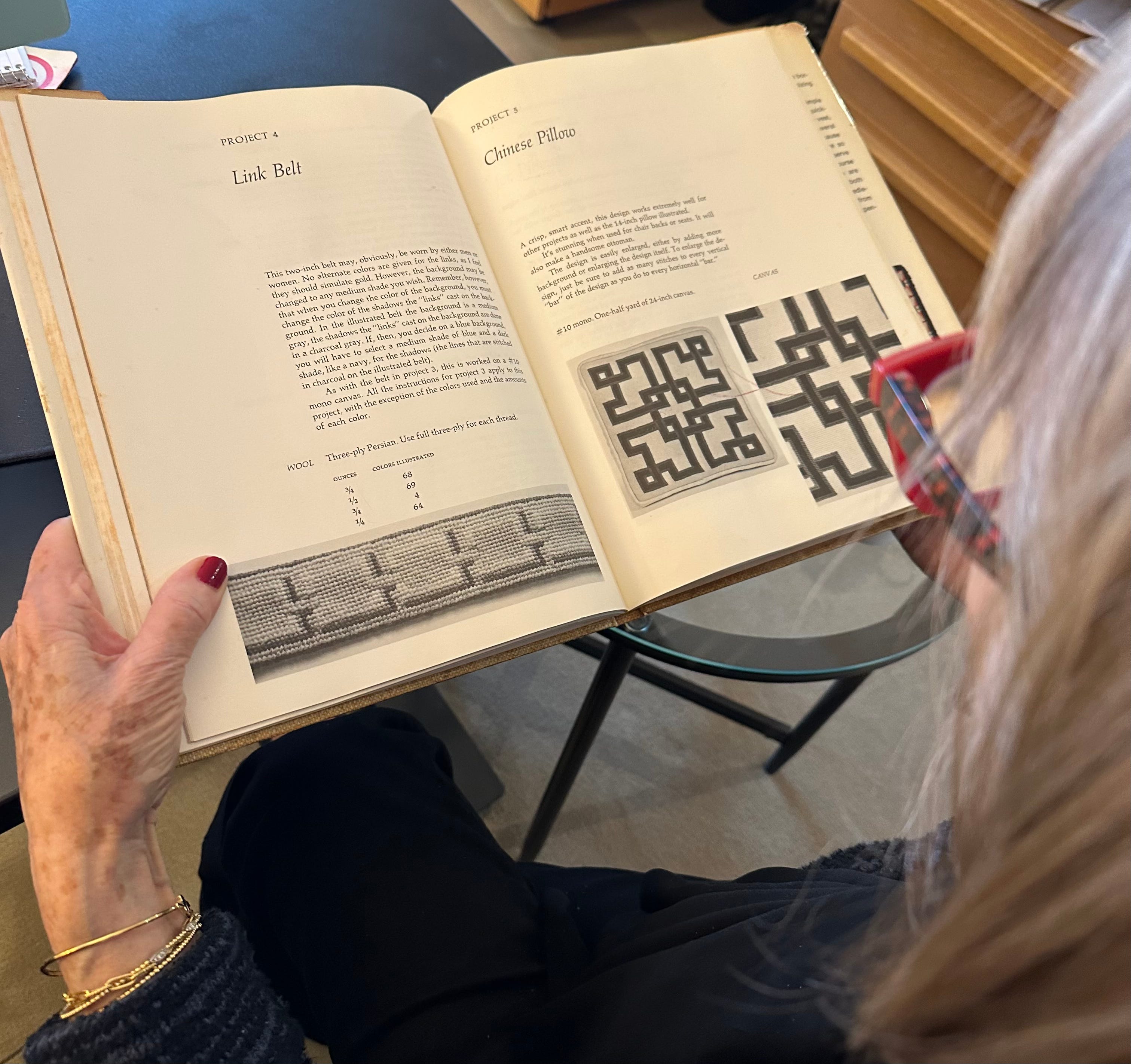
Why we remember some life happenings and not others has been an ongoing theme over my many months of Substack posts and my many years of memoir writing, but why we keep some actual things and not others is an equally puzzling and intriguing question.
In our modest storage bin down the hall and around the corner, I was reminded of this the other day when I went looking for an ornament. There in the back taking up space was the large illustrated volume by Morton Da Costa entitled Book of Needlepoint that I have had forever. Why do I still have it? When did I get it? First I took a needlepoint class at a local shop, and then I made a sampler with all the basic stitches that I gave to my mother, and then, later, I must have bought the DaCosta book.
I was going to make four pillows, all of them the same, all of them a considerable needlepoint challenge. (“Start with a piece of canvas eighteen inches square. Bind edges with masking tape…”) Now, looking at the photo of the finished pillow in the book, I can’t be certain that I really meant to make it, let alone four of them. Da Costa calls the work, “Chinese pillow” (although it looks more Greek-inspired to me) “stunning” and surely it is, but, really? When was I going to do this?
I think I still have DaCosta’s book because some part of me never wanted, to this day, to admit I probably wasn’t going to make the pillows, stunning or not. And because I still want to make the pillows. (“Using the Basketweave stitch…”) Yes, I do. I really do.
Maybe the book represents my hopes. I think that’s it: hopes. Maybe that’s what it always represented. Maybe that’s why I bought it in the beginning. When I was stitching my mother’s needlepoint sampler, I remember pulling the needle through the single weave canvas in our dimly lit living room — it was a subdivision house with an unlikely cathedral ceiling — sitting on the sofa at two or three in the morning, unable to sleep, knowing that I could not push my needle with its three-ply wool through enough of the holes of the canvas mesh to make my marriage work. I could make a pillow, but I could not make my marriage work, not even in a house with a cathedral ceiling. If I finished the pillow, I think I was still thinking, things would somehow get better. Morton Da Costa was going to help me.
Yes, that’s why the clunky book will be with me forever. If I made that Chinese pillow, one day, yes, if I made all four of those Chinese pillows, all would stay well with my world. I can still do it.
The other book, also large, but in thickness, not overall size, is The Oxford Companion to English Literature, Third Edition, compiled and edited by Sir Paul Harvey. He apologizes early on for not being able to make it even fatter: “I only regret that considerations of space and the limited scope of the work have made it impossible to incorporate all the additions that they (friends, correspondents, librarians) proposed.” The book is mainly literary references, but Sir Harvey explains in the preface that it is intended to be a companion to “ordinary everyday readers” and thus includes such non-literary entries as Röntgen Rays, in which we learn that the German physicist Röntgen, being uncertain as to the nature of the electromagnetic waves he had discovered — waves “possessing the power of passing through certain opaque substances” — called them X-rays. (This entry brought to mind Elon Musk, except that in his unfortunate usage, he applies unappealing letters and numbers to once-popular short-post platforms and even, very sadly, to his children.)
The book is 931 pages of such Röntgen-Ray quaintness and ends with an indecipherable table showing the day of the week on which the first of each month falls according to the dominical letter of the year, with a double dominical letter indicating a leap year. Why we, ordinary everyday readers, would need to know this or even what a dominical letter is is not discussed, nor do we ever learn why knowing that Connecticut (see United States) is the nutmeg state is important to our literary being.
The book currently is being used to hold up our dated ATT U-verse TV box behind the Ikea sleeper sofa and so I rarely consult it. But it, too, shall be with me forever.
I was given the book as a prize when I was chosen as the outstanding senior journalist in my graduating class of 600 at Redford High School in Detroit. One might think I have kept the book to this day as a matter of pride, but no. It is more a remembrance of my adolescent cluelessness, a reminder of my inability to take myself seriously as a writer, my unawareness that I needed to jump outside the 50s American culture and imagine myself as a female person whose ideas might possibly be taken seriously upon occasion. I do mention the book early in my memoir, as I trace the arc of my journey toward awareness of self, awareness of the world in which I was living, and how I might make my way through it and beyond it.
I will probably never need to know that Eliza Cook’s most popular poem (1870) was “The Old Arm Chair” or that Daniel Dancer was a famous miser (1716-94) in whose wretched hovel large sums of money were found after his death, or that the firing of the canon at the end of Act I of Henry VIII caused the burning of the Globe Theater in 1613.
Why did I not also keep the huge Random House Dictionary that my parents gave me for a 30-something birthday? I remember being so pleased; it represented a recognition by them of me, their daughter, as a serious writer who needed access to dictionaries of some heft.
And, for that matter, why did I not keep the Oxford English Dictionary that came in two volumes in a case with a little drawer at the top in which a small magnifying glass fit? You pulled out the tiny cardboard drawer when you wanted to see a word magnified. Why not? In a corner of my office here, I could have built a book tower, a monument of remembrance to all the dictionaries that once weighed something and are now a mere whisper in the ether on our cell phones.
I could go online and probably find some dictionaries of amazing heft with which to build my book tower. But that isn’t the point. These books I’ve kept for five decades and more have meaning because I’ve kept them. Why, I think after writing these 1,188 words, is still not quite clear. Hope? Self-awareness? A remembrance of my high school journalism teacher? I will never know, but I will keep dusting them, and even, once in a while opening them and remembering…